A handwoven Dhakai jamdani and a machine-made copy can look alike in a photo. In your hands, they feel and behave very differently. Here is what to check before you buy.
Turn it over
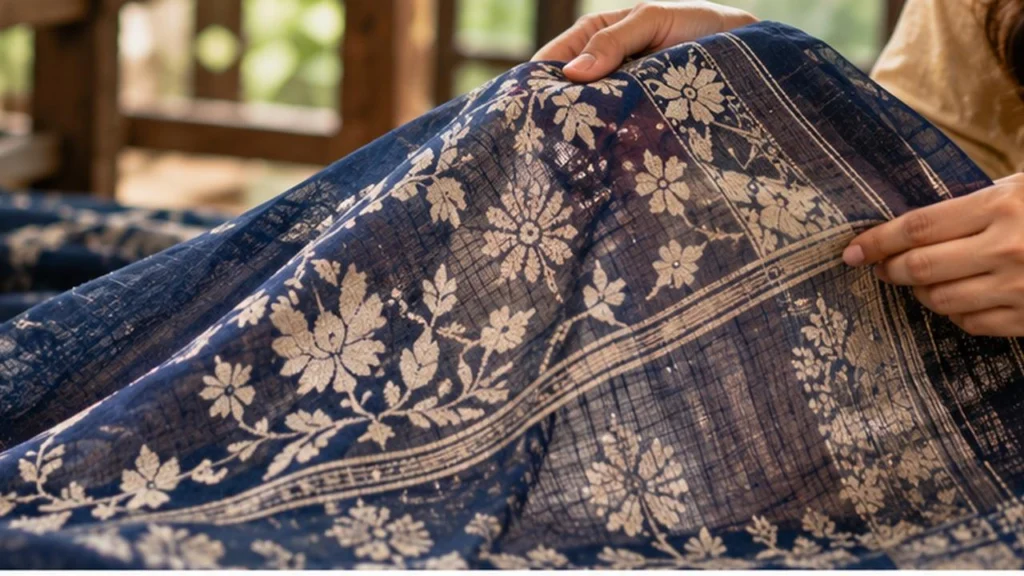
On a real jamdani, the motifs are woven into the cloth, not printed or embroidered on top. The back looks almost the same as the front, with the extra threads cut close or carried neatly. Machine copies usually show long loose floats on the back.
Look for small irregularities
A weaver adds every motif by hand, so two motifs are never perfectly identical. Slight differences in spacing are a good sign. A perfectly uniform pattern over 5.5 metres usually means a machine.
Hold it up to the light
Jamdani is woven on a fine, open cotton base. Against light you will see an airy, slightly transparent ground between the motifs.
Ask about the time and the price
A fine jamdani can take weeks on the loom. If a “pure jamdani” costs the same as a printed saree, ask questions. A good seller will tell you the fabric, the length, and whether a blouse piece is included.